
British hallmarking is one of the oldest forms of consumer protection in the world, dating back to 1300. The word itself comes from Goldsmiths’ Hall in London, where silver was taken to be tested and marked. Learning to read the marks is the quickest way to understand what you have.
The main marks
- Sponsor’s (maker’s) mark – the initials of the maker or firm responsible for the piece, usually inside a shield.
- Standard mark – confirms the silver content. In England the lion passant indicates sterling silver (92.5%). Scottish sterling was marked with a thistle until 1975, and a lion rampant after that. A figure of Britannia indicates the higher Britannia standard (95.8%). Since 1999 the fineness has also been shown as a number, such as 925 or 958.
- Assay office mark – shows where the piece was tested: a leopard’s head for London, an anchor for Birmingham, a crown for Sheffield (a rose from 1975) and a castle for Edinburgh. Pieces marked at the former Chester and Glasgow offices are of particular interest to collectors.
- Date letter – a letter that changes each year, with the style of letter and shield changing with each cycle. Used together with the assay office mark, it dates a piece to a specific year. It has been optional since 1999.
You may also see a duty mark – the sovereign’s head, used between 1784 and 1890 to show that tax had been paid – or a commemorative mark, such as those struck for the coronation of Elizabeth II and the Silver Jubilee in 1977.
What hallmarks don’t tell you
- Weight – the weight of silver underpins its value, so our catalogue descriptions give weights in grams wherever possible.
- Quality and maker – a hallmark proves the metal, not the quality. Pieces by leading makers and retailers such as Garrard & Co or Mappin & Webb usually command more.
- Condition – dents, repairs, removed engravings and thin, worn areas all affect value.
- Silver plate – EPNS (electroplated nickel silver) and Sheffield plate may carry marks that look like hallmarks but are not solid silver.
- Continental silver – many countries use their own systems, with marks such as 800, 835 or 900 indicating lower silver content than sterling.
Real examples from our saleroom

A C.J. Vander solid silver canteen of cutlery for twelve made £3,000 in March 2025. Complete canteens by good makers remain in strong demand.
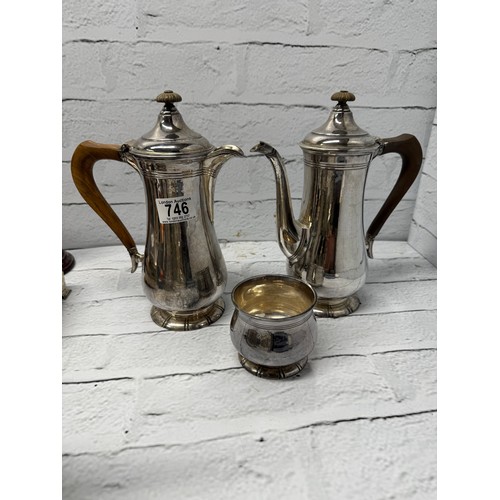
A pair of coffee pots and a sugar bowl by Wakely & Wheeler for Garrard & Co, assayed in London in 1953 and weighing 1,780g, made £900 in June 2025 – a good example of maker, retailer and weight all working together.
Unmarked or unclear?
If a piece has no hallmark, or the marks are worn, we can confirm its exact metal content with our non-destructive XRF testing – often while you wait.
Thinking of selling? Our team offer free, no-obligation valuations. You can drop in to our Wallington saleroom Monday to Friday, 8:30am–4:30pm, with no appointment needed, or send us photos for an online valuation. For smaller items, our Send Us a Box service lets you post them to us at no upfront cost.
